
AI Mode does not pick citations from the ten blue links. It rewrites your question into multiple synthetic sub-queries, retrieves a shortened set of documents for each one through a separate system called FastSearch, then writes an answer and cites the sources it leaned on. That shortened set is what I call the Grounding Pool: the abbreviated list of documents FastSearch returns per sub-query, and the only thing AI Mode can cite from. It matters because FastSearch runs on RankEmbed signals rather than Google’s full ranking stack, which Google conceded in court produces lower-quality results than fully ranked Search while still being usable for grounding. The measured result: Moz found 88% of AI Mode citations did not appear in the organic results for the same query (~40,000 queries, February 2026). Your job is no longer to rank once. It is to be retrievable across many sub-queries.
Why the official answer and the court answer do not match
Google’s own documentation is calm about all this. Its Search Central guide on AI features states there are <cite>no additional requirements to appear in AI Overviews or AI Mode</cite>, and that eligibility comes down to being indexed and eligible to show with a snippet.
Then the antitrust remedies filings landed, and we got a look at the plumbing. Grounding for Gemini runs through FastSearch, a retrieval path that pulls fewer documents and leans on a different signal set than the Search results you have spent years optimising for.
Both statements can be true at once. Google is telling you there is no secret schema tag, and it is right. It is also true that the retrieval path deciding your citation is not the one your rank tracker measures. That distinction is the whole article.
I write this as someone who spent six months telling clients “just rank and you will get cited”, which turned out to be roughly half right. Here is the version I would give now.
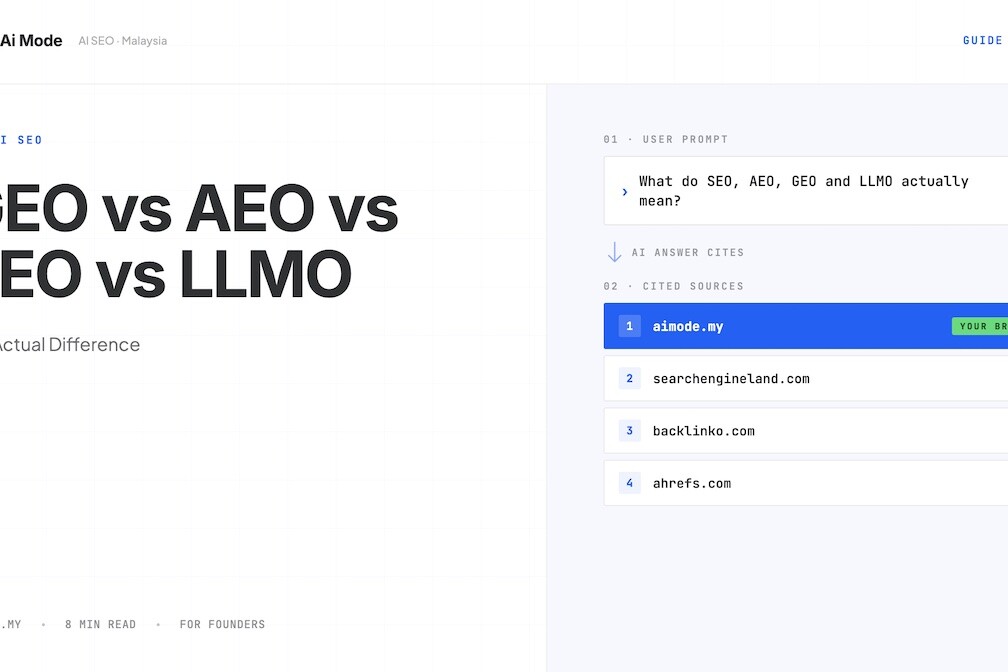
Find out the difference between GEO, AEO, SEO and LLMO
How does Google AI Mode actually pick its sources?
Quick Answer: Through a documented pipeline, not a ranking list. Google’s patent application US20240289407A1, “Search with stateful chat”, filed 28 February 2023 and published 29 August 2024, describes the architecture: the system takes your query plus contextual information about you and your device, runs it through a generative model, uses that output to generate synthetic queries, selects search result documents for them, then classifies the query using that combined state data and hands off to downstream generative models to write the response.
Read that sequence as a funnel with five places you can be eliminated, because that is what it is in practice.
Table 1. The AI Mode pipeline, and what decides your fate at each stage.
| Stage | What the system does | What decides whether you survive it |
|---|---|---|
| 1. Query interpretation | Reads the query plus contextual signals (session, device, prior turns) | Nothing you control. Personalisation and session state |
| 2. Synthetic query generation (fan-out) | Expands one question into multiple related sub-queries across subtopics | Whether your content covers the sub-questions, not just the head term |
| 3. Document retrieval | Selects a shortened set of documents per sub-query via FastSearch | Semantic proximity to that sub-query. Crawlability. Indexation |
| 4. Query classification | Uses the state data to classify intent and route to downstream models | Query type, which decides whether a link-heavy answer appears at all |
| 5. Synthesis and citation | Writes the answer, cites the sources it grounded claims on, and identifies further supporting pages while generating | Whether a passage on your page cleanly supports a sentence it wants to write |
Source: pipeline stages summarised from Google patent application US20240289407A1, “Search with stateful chat”, filed 28 February 2023, published 29 August 2024, Google LLC; and Google Search Central, “AI features and your website”, which describes query fan-out and the identification of additional supporting pages during response generation. Retrieved 19 August 2026. The right-hand column is our interpretation for practitioners, not language from either source.
Stage two is where most SEO thinking breaks. Google confirms both AI Overviews and AI Mode may issue multiple related searches across subtopics and data sources to build a response. So the query you optimised for may never be run verbatim. What gets run are its children.
Key takeaway: You are not competing for one query. You are competing for a dozen you never saw.
What is FastSearch, and why does it change who gets cited?
Quick Answer: FastSearch is Google’s internal retrieval system for grounding Gemini models. Court filings in the US antitrust proceedings describe it as built on RankEmbed signals, producing abbreviated ranked web results a model can use for a grounded response. It retrieves fewer documents than Search and Google acknowledged the quality is lower than fully ranked Search results, while remaining <cite>good enough for grounding</cite>. That shortened set is the Grounding Pool, and AI Mode cannot cite anything outside it.
RankEmbed is a deep-learning model that places queries and documents in a shared vector space and measures how close they sit. Semantic proximity to the sub-query does the heavy lifting. Traditional authority signals do not carry the weight they carry in core ranking.
Table 2. Two different retrieval paths, two different games.
| Classic Search | FastSearch (grounding) | |
|---|---|---|
| Documents retrieved | Full ranked web results | Abbreviated set, fewer documents |
| Primary signal basis | Full ranking signal stack | RankEmbed signals |
| Optimises for | Result quality | Speed, sufficient for grounding |
| Quality, per Google | Higher | Lower, acknowledged in filings |
| What you’re competing on | Rank position | Semantic proximity to a sub-query |
| Where you see it | Ten blue links | Sources cited in AI Mode and AI Overviews |
Source: characteristics drawn from the US v. Google LLC remedies memorandum and remedies-trial testimony cited within it (Rem. Tr. 3509:23–3511:4), as reported by Search Engine Land (13 November 2025) and Search Engine Journal (September 2025). Retrieved 19 August 2026. Google has not published FastSearch documentation, so this table describes what the filings disclose, not a complete specification.
There is a strategic reading of this that I think most agencies have missed. If grounding retrieval weighs semantic closeness more heavily and backlink authority less heavily, a smaller Malaysian site with genuinely precise content on a narrow sub-topic can enter the Grounding Pool that its rank position would never earn. That is not a loophole. It is the retrieval design working as described.
The metric worth tracking, and the one we now build into audits: Grounding Pool coverage, meaning the share of a query’s plausible sub-queries where your domain appears in the retrieved set. One ranking gives you one shot. Coverage gives you many.
Key takeaway: Stop asking “do I rank for this”. Start asking “for how many of this question’s children am I retrievable”.
Does ranking in the top 10 still matter for AI Mode?
Quick Answer: Less than for AI Overviews, and much less than most decks claim. Moz’s February 2026 analysis of roughly 40,000 queries found 88% of AI Mode citations did not appear in the organic results for the same query, with only 12% matching the top 10. For AI Overviews the link is stronger but weakening: Ahrefs’ March 2026 study of 863,000 SERPs and 4 million AI Overview URLs put top-10 overlap at 37.1%, down from 76% in its July 2025 study.
Table 3. How loosely AI citations track classic rankings.
| Surface | Measurement | Finding | Source, date |
|---|---|---|---|
| AI Mode | Citations appearing in organic results for the same query | 12% | Moz, ~40,000 queries, February 2026 |
| AI Overviews | Cited URLs ranking organic top 10 | 37.1% | Ahrefs, 863,000 SERPs / 4M URLs, March 2026 |
| AI Overviews | Same measure, earlier period | 76% | Ahrefs, 1.9M citations, July 2025 |
| AI Overviews | Same measure, different methodology | ~17% | BrightEdge, February 2026 |
| AI Mode (shopping) | Product overlap with standard search results | 0.8% | Productrise, 21 days of matched queries, July 2026 |
The Productrise row is the one I keep returning to. Same queries, same day, and the two surfaces agreed on under one percent of the products they showed. If that pattern holds for services, an e-commerce or comparison business could hold a dominant classic SERP and be a stranger in AI Mode.
Key takeaway: Ranking gets you into the index that FastSearch draws from. It does not reserve you a citation slot.
Which sources does AI Mode actually cite?
Quick Answer: Disproportionately platforms, not brand sites. Semrush’s 325,000-prompt study found LinkedIn cited in 13.5% of Google AI Mode responses. Profound’s analysis of 1.4 million citations from November 2025 to February 2026 found LinkedIn the most-cited domain for professional queries across all six major AI platforms, with ChatGPT and AI Mode pulling 59% of their LinkedIn citations from individual member posts rather than company pages. Wix’s March 2026 research found listicle-formatted content took 21.9% of AI citations, the highest share of any format.
Find out how to optimising for Bing Copilot.
Table 4. What the citation data says about source and format.
| Finding | Figure | Sample | Source, date |
|---|---|---|---|
| LinkedIn share of Google AI Mode responses | 13.5% | 325,000 prompts | Semrush, 2026 |
| LinkedIn citations from individual posts (ChatGPT + AI Mode) | 59% | 1.4M citations | Profound, Nov 2025–Feb 2026 |
| Listicle format share of AI citations | 21.9% | AI Mode, ChatGPT, Perplexity citations | Wix, March 2026 |
| Reddit share of Google AI Overviews top sources | 21.0% | 680M+ citations | Profound, Aug 2024–Jun 2025 |
That last caveat is not throat-clearing. Every one of those numbers describes a market where Reddit and LinkedIn carry enormous local content volume. Malaysian commercial queries have thinner platform coverage, which is exactly why our own measurement matters more here than an imported percentage.
There is a corollary worth stating plainly. If your Lead Strategist publishes substantive analysis on LinkedIn under their own name, that content sits on a domain with citation weight your own site will not match for years. I have mixed feelings about that as a business model. It is still what the data shows.
Key takeaway: Some of your AI Mode visibility will be earned on domains you do not own. Plan for that rather than resenting it.
What does this mean for a Malaysian business?
Quick Answer: Less urgency than the headlines suggest, and a specific window. AI Mode has been available in Malaysia since August 2025, initially English-only, and now runs in 200-plus countries and close to 100 languages. But SparkToro’s clickstream analysis found only 0.34% of searches moved into AI Mode between January and April 2026, even as Google reported at I/O 2026 that AI Mode passed a billion monthly users with query volume more than doubling each quarter. Small share, steep curve.
Our own State of AI Search in Malaysia study points the same way from the AI Overviews side. Across 8 commercial queries on 21 July 2026, five local-intent searches returned a Map Pack and no AI Overview at all. Eight queries is a pilot, not a benchmark, and I will keep saying so.
Here is the part that costs me money to write. If you run a local service business in Klang Valley, rebuilding your site for AI Mode this quarter is the wrong spend. Your buyers are still in the Map Pack. Fix your GBP, your reviews, and your service pages first, and revisit this in six months. The businesses that should act now are the compare-and-research ones: finance, insurance, B2B software, education, travel, healthcare information.
The language angle is where I would actually put early effort. AI Mode launched here in English and Bahasa Melayu support arrived later, which means the Malay-language grounding pool has had far less time to fill. Fewer quotable Malay passages means less competition for retrieval. That is the BM Blind Spot from our study, showing up on a second surface.
How do you measure AI Mode visibility?
Quick Answer: Incompletely, and anyone claiming otherwise is selling estimates. Search Console folds AI Mode data into the overall Web search type rather than reporting it separately, its Generative AI report carries no queries and no clicks, and a follow-up question inside an AI Mode conversation counts as a brand new query with its own impressions and position. So your averages are being diluted by conversational turns you cannot isolate.
Table 5. What you can and cannot measure, as of August 2026.
| What you want to know | Can you get it? | Best available approach |
|---|---|---|
| AI Mode impressions, isolated | No | Folded into Web search type in Search Console |
| Clicks from AI Mode citations | No | Generative AI report carries no click data |
| Whether you are cited for a given prompt | Partially | Fixed prompt set, run on a schedule, logged manually or via a tracker |
| Fan-out sub-query coverage | Partially | Prompt fan-out modelling, then check retrieval per sub-query |
| Referral traffic from AI surfaces | Partially | GA4 referral segmentation, undercounts by nature |
Source: Search Console reporting behaviour per Google’s documentation as summarised in industry tracking, August 2026. Right-hand column is Ai Mode reporting practice, not a Google recommendation.
One practical warning. AI Mode responses regenerate and personalise on session context, so a single check tells you close to nothing. Fix the prompt set, fix the schedule, compare like with like. Otherwise you will report noise as progress, which I have watched happen to two clients who were paying someone else for it.
Key takeaway: Report citation presence against a fixed prompt set. Never report AI Mode traffic as a clean number, because there isn’t one.
How to get into the Grounding Pool
- Confirm you are eligible at all. Indexed, crawlable, and allowed to show a snippet.
nosnippetand restrictivemax-snippetvalues remove you from AI features. This catches more sites than you would think, especially ones carryingnoindexleft over from staging. - Model the fan-out. Take a money query and write out the sub-questions a reasoning model would generate from it: price, comparison, eligibility, process, alternatives, local specifics. That list is your real target set.
- Cover each sub-question with its own liftable passage. Forty to seventy words, self-contained, with the specific figure in it. One page can serve several if the structure is clean.
- Match the format the data rewards. Comparison tables and clearly structured lists get retrieved and cited at higher rates than flowing prose. Use them where they are honest, not everywhere.
- Publish outside your domain too. LinkedIn under a named person with real credentials, and category-relevant forum participation, both feed pools your own site cannot reach quickly.
- Build the Bahasa Melayu set. Less competition for retrieval, and the pool is still thin. This is the highest-leverage item on the list for most Malaysian businesses, and the one most likely to get postponed.
Conclusion
AI Mode’s citation choice is not mysterious once you accept it runs on a different track. Your question gets rewritten into children you never see, a faster and shallower retrieval system pulls a short list of documents for each one, and the model cites what it leaned on while writing. Rank position is an input to that, not a ticket.
The number that should reset your planning is Moz’s: 88% of AI Mode citations were absent from the organic results for the same query. Whatever the sampling caveats, no reading of that figure supports “we rank well, so we will be fine”.
For Malaysian businesses the honest position is that AI Mode is not yet where your leads come from, and the curve says that changes faster than a content plan takes to execute. Build the coverage now, while the Grounding Pool for your category, and especially for Bahasa Melayu, is still half empty.
SEO consultants in Malaysia ranked by proof.
Frequently Asked Questions
How does Google AI Mode decide which sites to cite? AI Mode expands your question into multiple synthetic sub-queries, retrieves a shortened set of documents for each through a grounding system called FastSearch, then cites the sources that support the sentences it writes. Per Google’s patent application US20240289407A1, that pipeline runs query interpretation, fan-out, retrieval, classification, then synthesis. Ranking feeds retrieval but does not decide citation.
What is the Grounding Pool? The Grounding Pool is the abbreviated set of documents FastSearch returns for each sub-query. AI Mode can only cite what sits inside it. Because FastSearch retrieves fewer documents and leans on RankEmbed semantic signals rather than the full ranking stack, a precise page outside the top 10 can enter the pool while a higher-ranking generalist page does not.
Do I need to rank on page one to be cited in AI Mode? No. Moz’s February 2026 analysis of roughly 40,000 queries found 88% of AI Mode citations did not appear in the organic results for the same query, with only 12% matching the top 10. Ranking still helps by keeping you indexed and retrievable. Treat it as a prerequisite rather than the mechanism that earns the citation.
Is Google AI Mode available in Malaysia? Yes. AI Mode reached Malaysia in August 2025, English-only at launch, and Google has since extended it to more than 200 countries and close to 100 languages. Adoption is still early: SparkToro measured just 0.34% of searches moving into AI Mode between January and April 2026, against more than a billion monthly users reported by Google.
Can I track AI Mode rankings in Search Console? Not separately. Search Console folds AI Mode into the overall Web search type, the Generative AI report shows no queries and no clicks, and each follow-up question inside a conversation counts as a new query with its own impressions. Track citation presence against a fixed prompt set instead, and treat any “AI Mode ranking report” as an estimate.
What is query fan-out? Query fan-out is Google’s technique of issuing multiple related searches across subtopics and data sources to build one AI response, used by both AI Overviews and AI Mode. Practically, it means the query you optimised for may never run verbatim. Its sub-questions run instead, so topical coverage beats single-keyword optimisation.